
You get a job at Salesforce by building relationships before you apply, learning which role fits what you already do well, and walking into every interview with proof of your value instead of a list of duties. I came from 17 years in higher education with no tech background. What got me hired was a referral from someone inside, a five-slide Value Pitch I sent before every interview, and treating each rejection as coaching that pointed me toward the right role: Solution Engineer.
I want to be honest about how this went, because most "how to get a job at Salesforce" advice makes it sound like a checklist. It wasn't. It was six months of late nights, YouTube tutorials, and trying to earn an MBA in 24 hours. I interviewed for professional services, business value, solution engineering, and people and culture roles. I heard no on almost all of them.
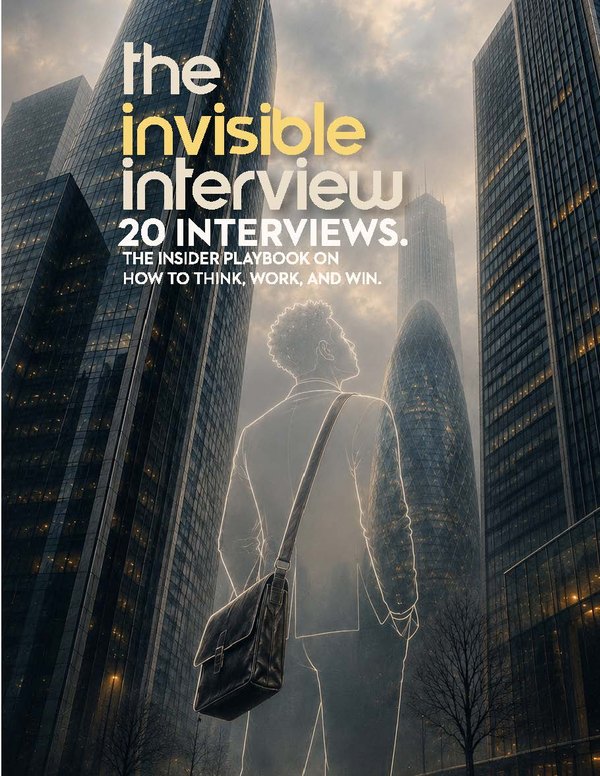
But every no taught me something, and I wrote all of it down. Those notes became The Invisible Interview. This page is the short version.
1. the job starts before you apply.
Most people don't land jobs in tech by clicking "apply" on a company website. They land them because somebody inside says, "You should talk to so and so."
For me, that somebody was Earl, a Salesforce account executive I met while leading a CRM project at Brown. Earl explained how referrals worked, broke down the culture, and made me read two books before he'd even talk to me about a role: Behind the Cloud and Trailblazer, both by Marc Benioff. Reading the founder's story before you walk into a company is one of the most underrated career moves out there. You stop sounding like a candidate and start sounding like someone who already works there.
A referral isn't a favor. It's the byproduct of trust.
I stopped sending "can you get me a job?" messages and started asking people, "How did you land at Salesforce?" I listened more than I talked. Curiosity turned into relationships, relationships turned into referrals, and referrals turned into interviews.
The 3x3 rule. Each week, reach out to three people at your target company. Ask about their path, not open roles. Track who you talked to, what you learned, and your follow-up.
2. learn the roles before you pick one.
When I first heard "sales," I pictured the pushy car salesman. Tech sales is not that. The deeper I got, the more I realized how many roles sit around the sale, and how many of them fit people from non-tech backgrounds:
- Account Executives run their own book of business. Strategists and relationship builders.
- Solution Engineers are translators. They show how the product works in a customer's world.
- Customer Success Managers make sure customers get the return they paid for.
- Business Value Consultants tie everything back to ROI and impact.
That's when it clicked: my higher ed background was my differentiator. I'd been listening to students and parents for years. Teaching is every demo in disguise. Building trust is how I kept programs alive. One recruiter told me, "Don't think of this like higher ed interviews. We want to know how you solve problems, how you collaborate, and how fast you can learn." That changed how I showed up in every conversation after.
3. send proof, not paragraphs.
I didn't "apply" twenty times. I built a Value Pitch: five slides, each one mapped to one of Salesforce's core values, each one telling a story from my career that proved I already lived that value. I sent it before every interview.
Here was the gag of it all. By the time I walked in, they weren't interviewing me. They were already working with me. Every question came off my deck. My stories. My framing. I walked in already knowing the test, because I'd written it.
build your own value pitch.
The 12-page framework I used for every leap I've made. Pick your shape, mine your proof, build it with AI, and send it before your next interview. Plus The Invisible Letter every Sunday.
Free. Unsubscribe whenever.
4. treat every no as coaching.
The first no stung. I'd prepped, I'd built my Value Pitch, and I still got "thanks, but no thanks" for a professional services role. In higher ed, rejection feels final. In tech, every no became a mini masterclass, because the people who said no kept pointing me somewhere else.
The second no came from a leader on the Equality team, about two minutes into the call: "This role is not a good fit for you." Then she leaned in and asked what I really wanted to do. She became a mentor later.
By my fifteenth rejection, I was ready to stay in higher ed. Then I made the final round for the Business Value team, and I bombed the ROI case. My story was strong. My math was not. Afterward, one of the team leaders pulled me aside and said, "You'd crush it as a Solution Engineer."
Sometimes you need a door slammed shut to notice the one that's been cracked open for you all along.
After every interview, send: "Thank you for the opportunity. If you're able, I'd love feedback to help me grow." Then write three lines: what went well, what to fix, and who to stay connected with.
5. the interview that got me in.
When I heard "Solution Engineer," I didn't fully know what the role was. Once I did the research, I realized I'd been doing SE work my whole career: listening, teaching, and explaining complicated systems in plain English. So I locked in:
- Doubled down on Trailhead and studied for the Admin certification.
- Binge-watched Solution Engineer demos on YouTube and studied Demo2Win.
- Built a practice Salesforce org that mirrored a real customer, and did a dry run with a working SE.
- Practiced one story arc until it felt natural: problem, solution, outcome.
The final interview was half slides, half live demo. This time I didn't just show features. I told a story about how Salesforce could change the customer's world. That's what landed.
Two days before I was scheduled to move back to Providence, my phone rang. It was Salesforce.
6. what i'd do if i were starting today.
- Pick two target roles, not one. Read three job descriptions for each and highlight the skills that repeat.
- Read the founder's story and learn the company's core values well enough to use them in conversation.
- Run the 3x3 rule every week until you have a referral.
- Build your Value Pitch and send it before every interview.
- Get hands-on. Open a free Trailhead account and build something small you can show.
- Ask recruiters better questions. "How technical is this role?" and "What gaps do you see in my background?" will save you months.
- Log every no. Rejections are data. Ask who else you should talk to.
None of this is Salesforce-only. It's how the invisible side of hiring works at any company where trust decides who gets in. Salesforce just happens to be where I learned it.
start with the value pitch.
It's the one thing I'd build before sending a single application. Get the free 12-page guide, plus The Invisible Letter every Sunday.
Free. Unsubscribe whenever.